How Can a Golden Egg Be Found in Ivf
Intracytoplasmic Sperm Injection (ICSI) – IVF
Intracytoplasmic Sperm Injection (ICSI) is a specialised course of In Vitro Fecundation (IVF) that is used primarily for the treatment of severe cases of male-factor infertility. ICSI involves the injection of a single sperm directly into a mature egg.
At Metropolis Fertility, nosotros use a medium named Sperm Slow™ during sperm selection. This medium contains hyaluronan (HA), which binds sperm that are more probable to have normal Deoxyribonucleic acid and thus allows selection of these bound sperm for injection. By selecting the sperm that are bound to HA and using them for ICSI, the embryologists are preferentially using the improve-quality, more than mature sperm. Please notation that, while this technique using HA is standard practice, it may not exist suitable in every case depending on individual circumstances.
Delight remember anyone can be afflicted by infertility and while it can be a challenging experience, the good news is that our specialists can help you explore the options available to achieve your dream of having a baby.
ICSI – IVF pace-by-stride guide
Delight click on the epitome below to view in total and download our infographic.
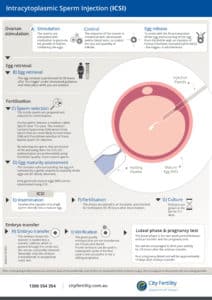
ICSI with Sperm Slow™ - IVF treatment procedure
Before ICSI can be carried out, mature eggs must be retrieved from the female partner during a standard stimulated IVF cycle.
Afterward the eggs are collected n theatre, the outer coating of cells (cumulus) is removed from each egg. Only then tin can we be sure the egg is mature enough to undergo ICSI.
Immature eggs cannot be injected. However, they can be incubated for a farther two to vi hours and reassessed. If they mature in that time, they tin can even so be injected along with the other mature eggs. You will exist notified the following day as to how many eggs from your collection were mature and how many were inseminated.
The male partner's semen sample is prepared in the lab to isolate healthy, moving sperm for the ICSI process. All debris, dead cells and the seminal plasma are removed in this process.
Motile sperm is selected for injection on the basis of their morphology (shape). This visual arroyo may non necessarily reflect their functionality or ability to fertilise an egg (oocyte). Sperm Slow™ provides a functional examination based on the ability of sperm to bind to HA – hydrogel mimicking the natural bounden of mature sperm to oocytes in the female.
A very fine special drinking glass instrument (called a belongings pipette) is used to agree the egg still. It is so small you lot can barely see the tip with the naked eye. A thinner, precipitous, drinking glass needle-like instrument is used to select and immobilise, then pick up a single sperm.
With great care and precision, the needle is gently inserted through the egg'due south outer coating (the zona pellucida) and into the egg itself. The immobilised sperm is so slowly injected into the egg and the needle is carefully removed, leaving the sperm behind within the egg.
The injected eggs are placed in an incubator overnight and checked the next forenoon for signs of fecundation. After an additional 24 hours, we can determine how many take divided and gone on to course embryos.
Information technology is important to annotation that not all eggs will fertilise, and non all fertilised eggs become embryos. As with standard IVF, the number of embryos replaced into the uterus depends on the woman's age and medical history. Provided the additional embryos appear good for you, and are progressing at the expected charge per unit of growth, they can be frozen and stored for future use.
What are the benefits of using Sperm Slow™ (PICSI)?
Sperm in vivo (in nature) encounters HA in the cervical mucus and in the cumulus matrix surrounding the egg. It is also found at the tiptop of the sperm caput. Penetration of the cervical fungus and cumulus matrix by the sperm in vivo is a critical chemical element in successful fecundation and subsequent embryo implantation (when the fertilised egg attaches to the lining of the uterus). HA is vital in this interaction.
Sperm Wearisome™ takes advantage of this naturally occurring encounter and allows the embryologist to select HA-bound sperm for injection. Past selecting the sperm that is spring and using them for ICSI, the embryologists are preferentially using the amend-quality, less DNA fragmented and more than mature sperm.
Sperm leap to HA are likely to have less DNA damage and a normal chromosome complement. While at that place is usually no visible divergence at the phase of eggs that fertilise, in that location is mostly better day-3 to solar day-v embryo development. Additionally, more blastocysts (day 5 to day 7 development) are bachelor for vitrification (freezing), and significantly college ongoing pregnancy rates have been shown for patients using ICSI with Sperm Tedious™ compared with standard ICSI, which is why nosotros utilise it as standard procedure in our labs.
The potential fertility improvement that this type of treatment may yield too depends on the adult female's age, diagnosis and the initial semen analysis, and should exist discussed with your specialist.
Please note: Patients using testicular sperm (where most sperm are not progressively motile) and patients with less than 1 million motile sperm in the last sample preparation may be unable to utilize Sperm Slow™.
Who is ICSI-IVF recommended for?
ICSI-IVF is recommended for couples who accept had poor or no fertilisation during standard IVF, as well as men who take:
- Poor sperm morphology (abnormally shaped sperm).
- Poor sperm motility (irksome moving).
- A low sperm count.
- An obstacle such as a vasectomy, which prevents sperm release.
- Antisperm antibodies (antibodies that are produced past the human's body and may inhibit sperm function).
- A vasectomy reversal that was unsuccessful or resulted in a low sperm count or poor-quality sperm.
What are the potential risks associated with ICSI-IVF?
For the egg:
Every bit ICSI is more invasive and requires more than handling than standard IVF insemination techniques, at that place is a small gamble (less than 2%) that the egg may exist damaged during the process – resulting in a non-feasible egg.
For the resulting child:
Thousands of children around the world have been born as a issue of ICSI. So far, there is no disarming evidence that the incidence of birth defects is whatsoever unlike with ICSI or IVF compared with children born to other parents of similar age and health.
The female parent's age at commitment, family history and the presence of pregnancy complications are the almost of import predictors of newborn health. Notwithstanding, it is possible that a boy born as a outcome of ICSI might have a fertility problem similar to his male parent'south.
Other factors to keep in mind
Some men have an acquired cause of their sperm trouble that nosotros know volition not exist hereditary (such every bit a vasectomy or spinal string injury). Still, other men have sperm issues that may accept been present since nascence. These may exist passed on to the male children due to a small chromosomal rearrangement or a deletion of a small portion of the Y chromosome. Likewise, men with very low sperm counts or an obstruction in their sperm ducts (vas or epididymis) may carry one of the cystic fibrosis (CF) genes. In this situation, the child may inherit the CF gene and if the female partner also carries one of these genes, in that location is a hazard of producing a kid who actually has CF.
Merely as the female parent's historic period influences the adventure of birth defects, men with very low sperm counts as well have an increased risk of producing a son with an abnormal number of sexual practice chromosomes (XXY or XYY instead of the usual XY). These children accept a normal physical appearance and are likely to have normal IQs, but they may develop learning difficulties, behavioural bug or infertility.
Claret tests can screen one or both partners for many (but not all) of these problems, including chromosomal rearrangements and CF carrier status. Genetic testing (amniocentesis or chorionic villus sampling) is besides available during the pregnancy to look for many of these abnormalities.
To acquire more, please read our fact sail: ICSI or visit our Patient information booklets page and download the In Vitro Fecundation (IVF) & Intracytoplasmic Sperm Injection (ICSI) PDF.
Source: https://www.cityfertility.com.au/fertility-services/ivf-treatment/intracytoplasmic-sperm-injection-icsi/
0 Response to "How Can a Golden Egg Be Found in Ivf"
Post a Comment